Across the country, councils and water organisations are facing the significant challenge of bringing multiple entities together under the Local Water Done Well legislation. This article is for leaders of newly forming Water Council Controlled Organisations who are thinking about successful establishment on Day 1 and beyond.
The sprint is on for Establishment Day 1
For Water Council Controlled Organisations (CCOs) “Day 1” isn’t moving. System selection, data migration: these things are all underway now and all need to happen. Systems will be ‘switched on’ one way or another, and Day 1 will be 1st July 2027 for many.
As a leader of one of these new Water CCOs, the key question you need to ask yourself is: what is my team doing to ensure our people and processes (having come from entirely separate ways-of-working with different identities) will be aligned, capable and confident to follow the new way-of-working on Day 1?
Your answer to this will determine if you are on track for a smooth establishment, or if you will rush it and make it a very hard, public and costly landing.
The foundations that give you people and process alignment, capability and confidence are multiple. So in order to help chart the way we have created this guide toa simpler, smarter Water CCO establishment, based on 40 years of transformation experience, and our recent years in Water entity establishment with those that have had their Day 1 already here in NZ.
Stop rushing forward and work back from Day 1
The System Integration (SI) partners will be rushing to land the tooling, your data team will be furiously trying to cleanse and migrate the data. It’s a sprint to the finish.
But Day 1 is of course only the end of the beginning. Shift your focus now to look at this through the lens of the end user as a ways-of-working problem: Who do I work for now? What is now expected of me in my daily tasks? Who is making the decisions that affect my work? Who do I hand off to? Which set of business rules are we following now? Which systems will I have to start using? Are there even enough devices for this to work?
To help you prioritise this ways-of-working thinking, we have listed the four things that can quietly (or very noisily) derail Day 1 for your programme
1
Underestimating the effort required to align processes and business rules
This is a consistently underestimated piece of work in a merger of this kind. Each legacy entity has its own version of how a work order is prioritised, a new connection is approved, how a leak is triaged, what counts as urgent, what gets escalated, what to bill, and what needs to be recorded.
Aligning those processes and the business rules underneath them is detailed, unglamorous work that takes longer than anyone expects. Left unresolved, it does not stay quiet: it surfaces as inconsistent service, disputed hand-offs, workarounds and data you cannot report on with confidence. People are creatures of habit, and they are tribal. Expect them to revert to ‘how we’ve always done it’ unless you go through proper alignment, change and training.
2
Underestimating the change involved for people
Establishment programmes tend to budget for the change of structure and underestimate the change of day-to-day habits. For a planner, a scheduler, a field crew member, a customer services advisor or a contract manager, this is a new employer, a new team, new systems, new rules and a new set of expectations all at once.
Treated solely as a communications exercise, it becomes a business continuity issue on Day 1. Treated as an operational discipline: planned, resourced and measured on adoption, it becomes the thing that holds the entity together at establishment and beyond.
3
Leaving change and training too late
Change and training are frequently scheduled as the final activities before go-live, which means they are also the first things compressed when the programme runs late. People then meet their new process for the first time in the week they are expected to perform it. The cost is not felt on Day 1 alone. It is felt in the months of rework, issue escalation and re-training that follow.
Top tip:
your expert T&D team are a mirror held up to your project. You might not always want to hear it, but you will get the honest assessment of preparedness, system testing and solution design completion from the people who have to go and stand up in a training room full of your staff, and explain to them how to do their job now.
4
Leaving it to already stretched establishment team members
Establishment teams are typically small and doing this on top of their day jobs, while still keeping water services running. Asking the same people to also design processes, write procedures, build training and support end users is how good intentions turn into thin documentation and a hold-on-to-the-seat-of-your-pants establishment.
Risk, rework, greater cost later, and less than ideal terms with your staff and customer base is what you can expect if you play it this way.
Where Sysdoc come in
Don’t lose any more time
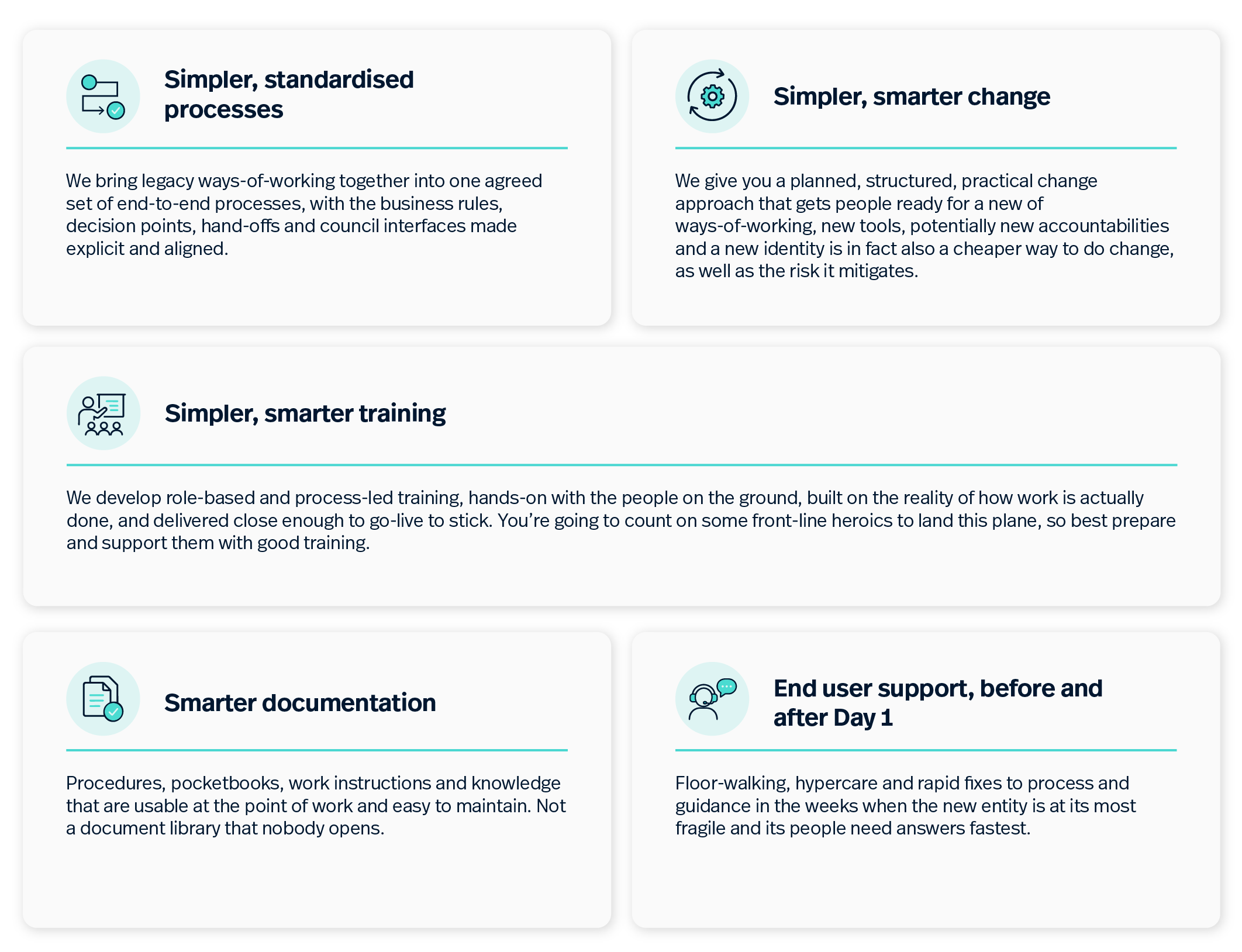
The earlier you start this conversation the more options you have and the less it will cost. Bring us in to help with your thinking now, and we can work with you to plan your change, prioritise delivrables to suit your budget, sequence the work, leverage the team you already have and ensure a pragmatic, fit-for-purpose approach.
One that takes the risk and the chaos, cost and risk out of establishment and leaves you with an entity that is sustainable long after Day 1.
Learn more about our services for water utilities here
No items found.
No items found.
No items found.
No items found.
Insights & News
Stay updated with Sysdoc's insights, events and news - dive into articles, trends, company updates, and thought leadership pieces.