
Policy training has long been treated as a compliance ‘tick-box’ exercise: something organisations do to satisfy regulatory requirements, with limited or no meaningful behavioural change. We’ve all been through it: huge volumes of policies with a lot of attestation that ‘I fully understand and will comply’.
Worse still, the job of closing the 'relevance gap' between what I need to do differently in my specific role day to day, and the 20+ policies that are generic enough to cover an entire organisation, is left entirely to the individual learner.
This annual ritual is essential from an organisational perspective. It is also, at best, from a behavioural change perspective, hopeful.
The result? Staff ‘complete’ the training but rarely convert that into meaningful behaviour change. At Sysdoc we believe this shouldn’t be a trade-off, especially in the age of GenAI.
With GenAI, we now have a superpower that can access and use the enormous datasets of organisational knowledge, rules, organisational memory, and deliver learning tailored to each individual.
Our learning experts set out to prove this in the real world...or at least in a galaxy, far, far away, a long time ago.



An engaging, context-rich (and fun) AI-powered learning experience tailored to the learner’s individual role, that draws on a massive dataset of policies and procedures that gives the learner real-time feedback on the level of mastery (or disturbing lack of mastery) of executing tasks in accordance with company policy.
To prove this real-world application, we needed a hypothetical organisation to model it on. One that has a vast organisational structure, a large and complex role matrix, with enormous datasets of information, a lot of complexity and risk, and countless lessons learned, all factors that make organisational policy crucial.
The client organisation we landed on was:
The Death Star*. Of course.
Taking place shortly after Luke blew up the very first Death Star, The Empire (like any large organisation would) reacted by gathering lessons learned, updating its policies and procedures and re-issuing the annual policy training to its (1.7 million, apparently) staff and sub-contractors inside the newly constructed Second Death Star.
The Empire needed to know that, as a staff member or sub-contractor, you are capable of undertaking your role in a way that protects against the risks and harms that the policies were in place for.
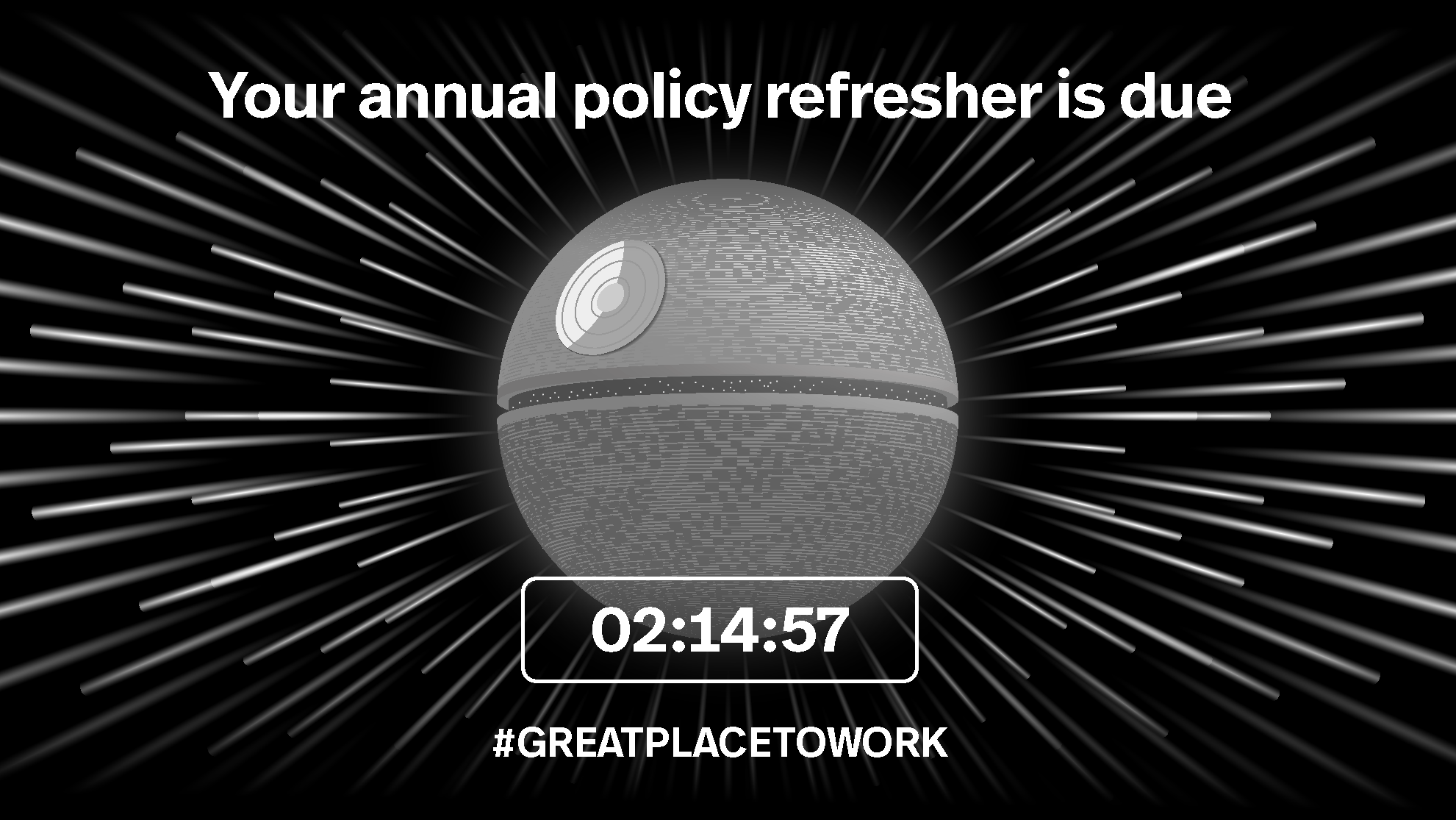
Watch the opening credits we used to put learners in the zone:
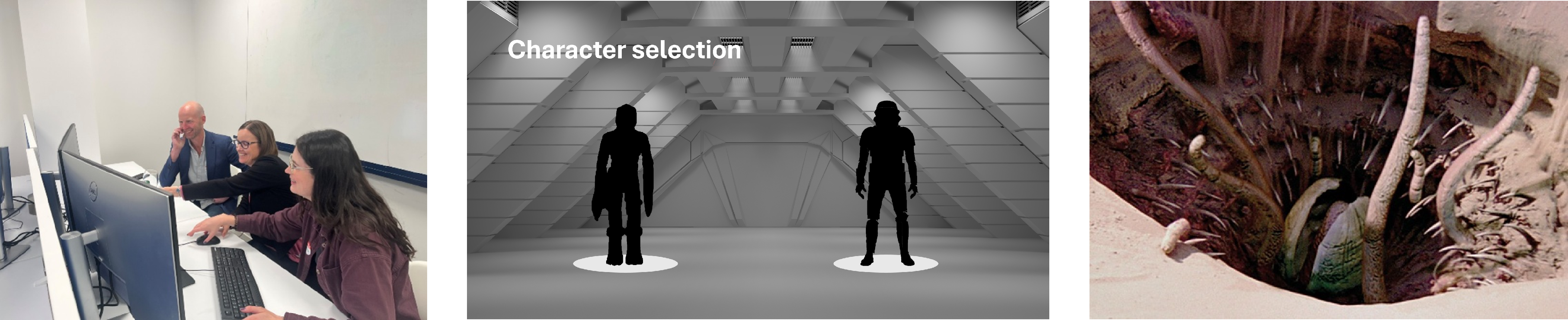
As a pair of learners, you select your role and are briefed on the objective of applying company policies in scenarios relevant to your specific job. The mission is time-bound, and you are competing against your peers in real time.
You and your teammate have two asynchronous AI agents to achieve your mission:
Based on your performance, you have either met the threshold to continue to be a staff member, or are handed over to the The Sarlaac, who will handle your performance management process from here on.
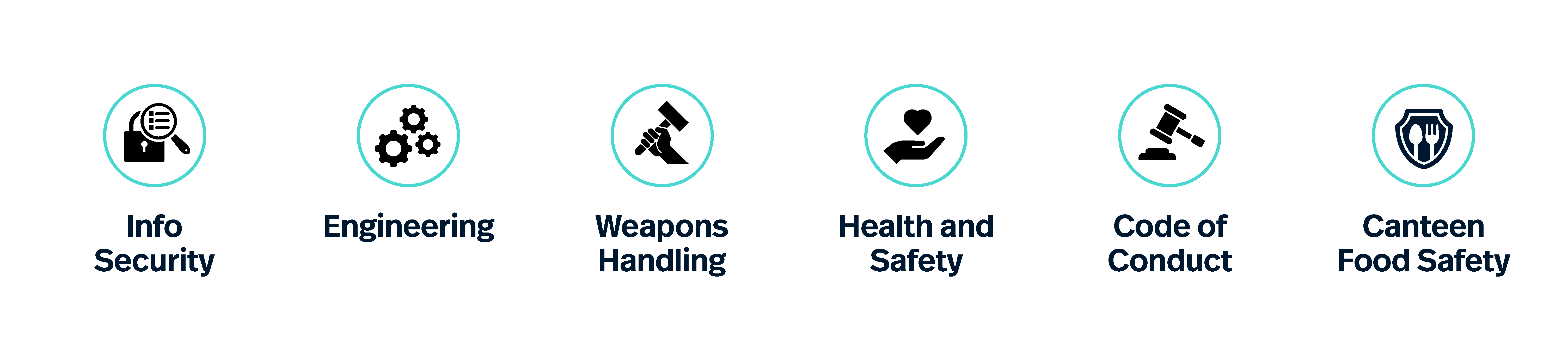
The datasets we used called on the typical compliance sources like regulatory standards and (recently updated) policies and procedures, including:
We also included artefacts that are not typically used in compliance training but are no less critical to the organisational memory that guides how things are actually done in the workplace.
Learners were able to reference the Galactic Commission of Inquiry (regulator's viewpoint), public commentary from popular Galaxy blogs (external sentiment), external press releases (PR damage), and numerous strongly worded company memos (internal sentiment and politics).
Sysdoc Behavioural Psychology Note: All of these stories, beliefs, myths, language, social proof, norms, etc, make up the powerful and invisible hand that directs ‘how we actually do things around here’, especially in the small moments when no one is watching. These contribute to ‘the why’, bring nuance, and represent a significant untapped opportunity to drive organisational behaviour change more broadly. If you want to drive behaviour change, pay attention to the above.
When tested across 20+ organisations, participants described the experience as:
"A safe space to practice decision-making under pressure"
"Moving away from annual refreshers that lack relevancy"
"Incredibly engaging and fun!'
"Adaptive and nuanced, like solving a problem in the real world"
"Providing an on-demand tool for policy application at the moment of need"
“Was this modelled on… our organisation?"
The verdict? Organisations saw this as a strategic shift: from mandatory training to empowered learning that protects compliance and truly builds capability.
For business leaders, this isn’t just about compliance: it’s about risk reduction, culture change, and performance uplift, all at a greatly reduced cost. By taking this approach with Sysdoc, you can:
This solution is also not just a single moment in time. It also provides an ongoing in-the-flow of work learning resource, enabling employees to check and apply relevant policy guidance in real time.
*Not an actual client of Sysdoc. We’re more discerning than that.
**In the event that the owners to the rights of the Star Wars franchise contacts us, we are not using this for commercial gain. We are, however, available to provide learning design advisory should the plot of the next episode feature themes of addressing organisational compliance and behaviour change.
Stay updated with Sysdoc's insights, events and news - dive into articles, trends, company updates, and thought leadership pieces.
Get in touch with our team to see how we can help your business.


